 Step into a journey through the discovery, understanding,
and application of an element of science.
Step into a journey through the discovery, understanding,
and application of an element of science.
Visualizing Possible Human Migration to Mars Caves
This STEM curriculum funded by NASA SCoPE (Science Mission Directorate Community of Practice for Education) NASA SCoPE.
Table of Contents
Teachers: Tap or click on Curriculum Notes for details about how each section aligns with curriculum standards.
-
Welcome to the Exploration of the Unknown
Curriculum Notes
- Science & Engineering Practice: Obtaining, Evaluating, and Communicating Information
- The entire curriculum requires students to obtain information from various sources (text, videos, websites) and communicate their findings.
-
What is Mars?
Curriculum Notes
- MS-ESS1 Earth's Place in the Universe
- Addresses the properties and features of objects in the solar system by discussing Mars, its climate, and geological features (pp. 4, 8).
- NCDPI-ESS.6.1.4
- Students are asked to use links to NASA websites to learn about the ongoing space exploration, such as the Mars Odyssey orbiter and the Curiosity rover, to understand the size and scale of the solar system (pp. 4, 12).
- NCDPI HS Earth and Environmental Science
- The curriculum heavily aligns with the "Earth's Place in the Universe" and "Human Sustainability" standards. Planetary Science: The entire premise of exploring Mars' environment, geology (caves, lava tubes, ice), and atmosphere CO2 is central to Earth Science standards concerning other celestial bodies (pp. 4, 8, 26).Natural Resources: The focus on utilizing in-situ resources on Mars (ice, atmospheric CO2, regolith) to produce water, oxygen, and food directly addresses human reliance on resources and the design of sustainable solutions (pp. 25, 31).Geology: The comparison of Earth and Mars cave formations (karst vs. lava tubes) and the search for subsurface ice aligns with geological processes and formations standards (pp. 13, 15, 26).
- Science & Engineering Practice: Planning and Carrying Out Investigations
- Science & Engineering Practice: Using Mathematics and Computational Thinking
- Why Does NASA Study and Explore Mars?
-
Will Humans Migrate to Mars Someday?
Curriculum Notes
- Science & Engineering Practice: Asking Questions and Defining Problems
- Science & Engineering Practice: Engaging in Argument from Evidence
-
Where do we live on Mars?
Curriculum Notes
- MS-ESS2 Earth's Systems
- The discussion of Mars's lack of a magnetic field and the resulting radiation exposure connects to understanding Earth's systems and protective qualities (p. 7). The mention of subsurface ice on Mars and the cycling of water through a heating process relates to the water cycle and energy transfer (pp. 24, 26).
- HS-ESS2 Earth's Systems
- The content on Mars' lack of a magnetic field and the resulting harsh radiation connects to understanding Earth's protective systems and how geological factors control life's evolution
- NCDPI-ESS.2.1.1
- The discussion of how Earth is protected by its magnetic field from radiation touches on how energy from the sun warms and affects planets (p. 7).
- NCDPI-ESS.6.1.2
- The lessons address the comparison of planets by describing Mars's environment and its inability to sustain life in contrast to Earth, due to its atmosphere, gravitational force, and distance from the sun (p. 7).
-
Caves on Mars
Curriculum Notes
- Science & Engineering Practice: Analyzing and Interpreting Data
- Caves on Earth
- What is it like in Mars caves?
- What is it like in Earth caves?
-
What is common between Mars and Earth caves?
Curriculum Notes
- NCDPI-PS.PSc.7.1
- The concept of specific heat and how it allows rock caves on Mars and Earth to maintain a stable temperature is directly related to understanding thermal energy and its transfer (p. 16).
- NCDPI HS Physics
- Physics standards related to energy transfer and forces are touched upon. Energy Transfer: The concept of specific heat is explicitly introduced to explain why cave temperatures are stable, aligning with standards on thermal energy and its transfer (p. 16). Forces and Motion: Although not central, the engineering aspects of rover design and potential human travel involve the application of physics principles, which can be connected to broader standards in mechanics. Electromagnetism: The mention of Earth's protective magnetic field and using bacteria to generate electric currents links to concepts of magnetic fields and electricity generation (pp. 7, 33).
-
Can we possibly live in Mars caves?
Curriculum Notes
- HS-ESS3 Human Sustainability
- The entire project addresses how humans depend on Earth's resources and how science can design solutions for sustaining life elsewhere. Students engage in arguments using evidence to support claims about living in Mars caves
- MS-LS1 From Molecules to Organisms: Structures and Processes
- The material explains that living things are made of cells, and that cells need oxygen and water to create energy (pp. 20, 24). The document also describes photosynthesis and how it relates to the cycling of matter and energy, particularly in the context of cyanobacteria's ability to produce oxygen (p. 21). The lesson on using bacteria to produce oxygen and food from Martian resources ties into the role of organisms in ecosystems (pp. 21, 31).
- HS-LS1 Structure and Function
- The discussions on how cells use oxygen for ATP production and the function of specialized bacteria relate to life's functions at the cellular level
- NCDPI-LS.7.1.2
- By explaining that cells need oxygen to create energy (ATP), the curriculum introduces the function of cells and their structures, such as mitochondria, which is a component of this standard (p. 20).
- MS-LS2 Ecosystems
- Interactions, Energy, and Dynamics: The lessons discuss using bacteria for food, oxygen production, and waste management, which are all key interactions and energy dynamics within a closed system or ecosystem (pp. 21-22, 31, 34).
- HS-LS2 Ecosystems: Interactions, Energy, and Dynamics
- The use of cyanobacteria for oxygen production and food sources directly addresses the cycling of matter and flow of energy in aerobic conditions. This includes how photosynthetic life (cyanobacteria) fundamentally altered Earth's early atmosphere through oxygen production (pp. 21, 31).
- NCDPI standards for Chemistry
- Several sections connect to core chemistry standards within the "Matter and Its Interactions" and "Energy" strands. Chemical Reactions & Stoichiometry: The document explicitly provides and discusses chemical equations, such as hydrogen peroxide decomposition 2H2O2 ⤏ 2H2O+O2 and the conversion of carbon dioxide to sugar CO2 ⤏ CH2O ⤏ C6H12O6 (pp. 22-23, 32). This ties into the mole concept and balancing reactions.Properties of Matter: The discussion of calcium carbonate formation in karst caves and the process of "baking" water out of Martian soil relate to matter properties and phase changes (pp. 13, 24).Acids and Bases: The mention of calcium hydroxide as "limewater" used in the CO2 scrubber relates to acid-base chemistry concepts (p. 25).
- MS-PS1 Matter and its Interactions
- The chemical reactions used to produce oxygen and water, such as converting carbon dioxide into oxygen and hydrogen peroxide into water, directly relate to this standard (pp. 22-23, 25).
- HS-PS1 Matter and Its Interactions
- The text mentions specific chemical reactions, such as the conversion of hydrogen peroxide into water and oxygen, and carbon dioxide into sugar, which relates to understanding composition changes during chemical processes (pp. 22, 27, 32).
- NCDPI-8.P.1.3
- The curriculum presents chemical equations, such as the process to convert carbon dioxide into oxygen and hydrogen peroxide into water, which demonstrates chemical changes resulting from reactions (pp. 22-23, 25).
- MS-ESS3 Earth and Human Activity
- The entire curriculum is centered on preparing for human exploration and potential migration to Mars, which addresses how human activity might impact Earth's systems and other planets (pp. 5, 18). It also explores using natural resources from Mars, such as water from Martian soil and ice, and carbon dioxide from the atmosphere, which is tied to the concept of natural resource distribution and human reliance on them (pp. 24-26, 32).
- NCDPI-LS.7.1.1
- The lessons on cyanobacteria and other microorganisms explain how these single-celled organisms can perform basic life functions, such as producing oxygen and acting as a food source (pp. 21, 31).
- NCDPI-8.L.2
- The document explores the use of biotechnology to affect living organisms, including using bacteria to produce food from human waste and convert carbon dioxide into sugar, which is a core concept in this standard (pp. 32, 34).
- MS-PS3 Energy
- The concept of specific heat is explained in the context of why caves maintain a stable temperature, linking it to the transfer of thermal energy (p. 16). The curriculum also discusses different energy sources, such as solar power and using bacteria to generate electricity (p. 33).
- HS-PS3 Energy
- The discussion of specific heat capacity in rocks to maintain stable cave temperatures connects to the relationship between the type of matter and energy transfer (p. 16). This also includes using bacteria to generate electric currents for power (p. 33).
-
Missions
Curriculum Notes
- Science & Engineering Practice: Constructing Explanations and Designing Solutions
- Engineering Design (ETS1.B)
- The culminating "Mission 1" and "Mission 2" challenges (designing a cave habitat and presenting the idea) align with the engineering core idea of designing solutions and evaluating criteria for trade-offs
- This is the Science & Engineering Practice: Developing and Using Models
- Acknowledgements
- References
- Additional Resources
Welcome to the Exploration of the Unknown
This STEM curriculum funded by NASA SCoPE (Science Mission Directorate Community of Practice for Education) is developed to stimulate your curiosity and to imagine the possible migration of humans to Mars. Our universe is filled with the unknown. We need to embrace the uncertainty and mysteries of the universe. Also, we need to be brave to develop extraordinary ideas.
Let's kick off our imaginary adventure to the universe with this famous poem by U.S. poet laureate Ada Limón. This poem is engraved on NASA's spacecraft Clipper and currently traveling in our solar system.
Arching under the night sky inky
with black expansiveness, we point
to the planets we know, we
pin quick wishes on stars. From earth,
we read the sky as if it is an unerring book
of the universe, expert and evident.
Still, there are mysteries below our sky:
the whale song, the songbird singing
its call in the bough of a wind-shaken tree.
We are creatures of constant awe,
curious at beauty, at leaf and blossom,
at grief and pleasure, sun and shadow.
And it is not darkness that unites us,
not the cold distance of space, but
the offering of water, each drop of rain,
each rivulet, each pulse, each vein.
O second moon, we, too, are made
of water, of vast and beckoning seas.
We, too, are made of wonders, of great
and ordinary loves, of small invisible worlds,
of a need to call out through the dark.

Activity 1: Warm Up Your Creativity
Watch this NASA video and imagine that you are in a spacecraft one day traveling in our solar system.
A poem for Europa by U.S. Poet Laureate Ada Limón
Challenge 1: Let's Write a Poem!
You can learn more about how to write a space themed poem! https://www.jpl.nasa.gov/edu/resources/project/write-a-poem-about-space/
Type your space poem here:
Now you can email your poem to someone, or download and save it.
Email your Poem:What is Mars?
Mars is the fourth planet from the Sun. It is one of the easiest to spot in the night sky, and it looks like a bright red point of light (NASA, https://science.nasa.gov/mars/). It is very dry, cold and filled with carbon dioxide (CO2).
Do you know that we can check out the latest Mars’ weather information? Let’s take a look at the temperature on Mars. You can learn the latest Mars weather from Curiosity, a Mars rover that landed in 2012. Curiosity is diligently monitoring the weather on Mars and is sending it back to Earth. Isn’t that cool?
Activity 2: Learn Mars' Environment, Convert Scientific Units
Go to this NASA website and check the latest temperature on Mars:
https://mars.nasa.gov/layout/embed/image/mslweather/
Challenge 2: Mars Environment
Part One: Temperature Conversion
Can you convert Fahrenheit to Celsius? The image you viewed of Mars temperature only displays it in Fahrenheit, but scientists use Celsius more often. See if you can convert.
| Celsius = | (Fahrenheit - 32) * 5 |
| 9 |
- Subtract 32 from the Fahrenheit temperature
- Multiply that by 5
- Divide that by 9
- Now you have Celsius!
Check your work!
| Fahrenheit Temperature: | °F |
| Your Answer: | °C |
| Calculated Answer: | °C |
Part 2: Temperature Measurement Quiz
Do you know where and how the temperature was measured? Take a quick Quiz!
Why Does NASA Study and Explore Mars?
Have you thought about why NASA studies Mars? It is important to clarify goals when scientists plan big projects. NASA clearly defines four goals for Mars exploration:
- Determine if life ever arose on Mars
- Characterize the climate of Mars
- Characterize the geology of Mars
- Prepare for human exploration
We will focus on the last goal (prepare for human exploration) in this section as this is strongly tied with our main interest: will humans ever migrate to Mars someday?
Before humans migrate to Mars, what needs to be done? Yes, we need to send humans to Mars and back to Earth for the initial exploration. Excitingly, this giant step is already an on-going project and NASA is thinking about how to make exploration possible as early as the 2030's!! After this initial exploration, we may be able to start getting ready for the longer stay on Mars or even migration.
Now let's take a moment to study NASA's current technology for Mars exploration.
Activity 3: Let's Learn NASA's Current Technology for Mars
Go to NASA’s website to find the technology you are most interested in.
https://www.nasa.gov/humans-in-space/humans-to-mars/
Talk with others about what you learned and which technology interested you the most.
Challenge 3: How Long will it take to go to Mars from Earth?
Do you know how long it will take to go to Mars from Earth? You can take a look at the video in "Getting
There and Back" and read about the trip to answer the question.
https://www.nasa.gov/humans-in-space/humans-to-mars/#preparing
| Question | Your Answer | Correct Answer |
|---|---|---|
|
How many days does it take to get from Earth to Mars? 🌎 ➡ ️🔴 |
||
|
How many days does it take to get back to Earth from Mars? 🔴 ➡ ️🌎 |
||
|
How many days is the total round trip (assuming you stayed just like in the video)? 🌎 ➡ ️🔴 ➡ ️🌎 |
||
Will Humans Migrate to Mars Someday?
Now that you are more familiar with NASA's current preparation for human exploration on Mars as early as the 2030s. Do you think we will migrate to Mars someday after this initial human exploration? If so, when will it possibly happen? Will it be 2040s, 2050s, or much later?
Interesting fact: During the 1950’s, somebody already envisioned sending humans to Mars! His name is Wernher von Braun. A rocket engineer, who was originally from Germany and moved to the U.S. and greatly contributed to NASA's space science. In 1953, he published a book "The Mars Project." In his book, he visualized a Mars expedition with 10 spaceships and 70 crew members (Asner and Garber, 2019)! We don't think we can send 70 astronauts in the 2030's, but what he visioned could possibly happen 80 years from now.
Activity 4
Let's chat with your friends to see if humans will migrate to Mars one day. Start a discussion, see if you agree.
Challenge 4
If a human trip to Mars is a possible scenario, when do you think we can make it happen?
Select one of the time periods. Write your reason too.
- 2030's
- 2040's
- 2050's
- Much Later
Type Your Answers Here:
Now you can email your answer to someone, or download and save them.
Email your Answers:Where Do We Live on Mars?
Have you ever thought about what would be good locations to live on Mars? The Universe is filled with dangerous radiation. Earth is protected by something called a "magnetic field." We can think of the magnetic field like a shield or umbrella around the Earth that protects us from harmful radiation.
Mars does not have this magnetic field, so anything on Mars' surface is bombarded with harsh radiation. There is one way to avoid radiation on the surface. How do we do this? Yes, we can go underground! Mars is known to have many caves and these underground caves will protect humans when we migrate to Mars.
Activity 5: Magnetic Fields
Let's watch NASA's video to learn about magnetic fields.
https://svs.gsfc.nasa.gov/20068/
Challenge 5: Magnetic Fields
Why do you think Earth has a magnetic field but Mars does not? Chat with your friends and write your answers.
Now you can email your answer to someone, or download and save them.
Email your Answers:Caves on Mars
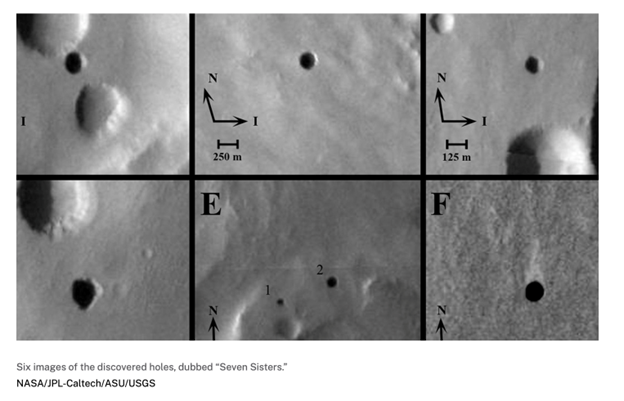
NASA has already spotted big caves on Mars. There are caves named the Seven Sisters! These caves have entrances ranging from 100 to 250 meters (328 to 820 feet), so they are much bigger than the caves on Earth ( https://science.nasa.gov/solar-system/planets/mars/nasa-orbiter-finds-possible-cave-skylights-on-mars/ ). We should be mindful that these caves were discovered by orbiters, spacecraft orbiting around Mars that cannot land on Mars’ surface. This means that there may be small caves on Mars that can not be detected by orbiters due to their small sizes.
Activity 6: Mars Caves
Let's look at more cave images from Mars’ orbiter.
https://ai.jpl.nasa.gov/public/projects/cave-rovers/
Challenge 6: Cave Entrances
Do you think caves with wide entrances are suitable for living?
Type your answers here:
Now you can email your answer to someone, or download and save them.
Email your Answers:Caves on Earth
Unlike caves on Mars, we can collect lots of information about caves on Earth. According to the National Caves and Karst Research Institute (2021), tens of thousands of caves are known globally, with more being discovered every day. Hundreds of cave entrances are known on Mars and the Moon—and await our exploration.
What can you learn about caves here on Earth? Visit Learn About Caves from the National Caves and Karst Research Institute and see what you can find out.
Here are some more places you can learn about caves:
- Explore the National Geologic Map Database and search for maps and charts of cave systems around the world.
- Take a deep dive into cave systems and their stories with Cave Systems & Trails Found Throughout the World, an ArcGIS Storymap.
- Discover Speleothems, the beautiful formations found in caves, with the U.S. National Park Service.
- Learn how to become a Junior Cave Scientist.
- Download these posters from the U.S. National Parks Service: Caves of the National Parks and Caves and Karst in the U.S. National Park Service
What is it like in Mars Caves?
One of the features about Mars caves that scientists are interested in is the temperature. As we learned in the previous section, Mars is very cold! We need to find caves that can be shelters for humans and have a warmer temperature. Recent study suggests that most Mars cave entrance temperatures are warmer than the surrounding temperature, which is good news. Scientists were able to collect temperature data through the Thermal Emission Imaging System (THEMIS) onboard the Mars Odyssey orbiter (Park et al., 2022). By analyzing these data, we have a better idea of what caves will be most suitable in terms of the temperature.
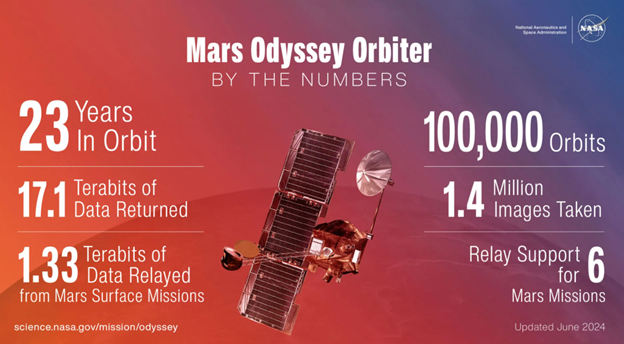
Activity 8: Mars Odyssey Images
Explore images from Mars Odyssey orbiter
https://science.nasa.gov/mission/odyssey/
https://themis.asu.edu/gallery
https://photojournal.jpl.nasa.gov/spacecraft/Mars%20Odyssey
Challenge 8: Mars Odyssey Structure
Take a look at the complex structure of the Mars Odyssey orbiter. What types of energy does it use to
keep collecting the data? Find "Meet the Mars Odyssey Orbiter" and "Tech Specs" on the Mars Odyssey mission site.
https://science.nasa.gov/mission/odyssey/
Type your answers here:
Now you can email your answer to someone, or download and save them.
Email your Answers:What is it like in Earth Caves?
Common Caves on Earth
Solution (karst) Caves
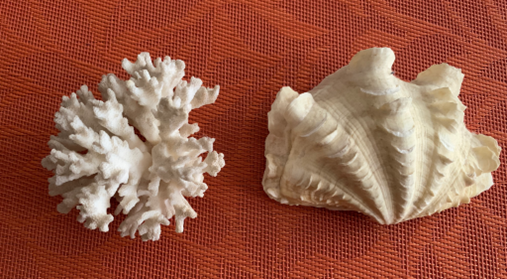
This is one of the most common caves on Earth. Corals and seashells in the ocean are made of molecules called calcium carbonate (CaCO3). When they die, these dead bodies made of CaCO3 are accumulated in the bottom of the ocean and create rocks called limestone. Limestones can be uplifted due to sea level changes and create beautiful geological sceneries called karst. Rains can seep through these karsts and create caves, stalagmites, and stalactites.
Visualization and Exploration
Let's observe coral fossils and seashells. These beautiful white components are made of calcium carbonate (CaCO3). These minerals mixed with rainwater create structures called stalagmites.
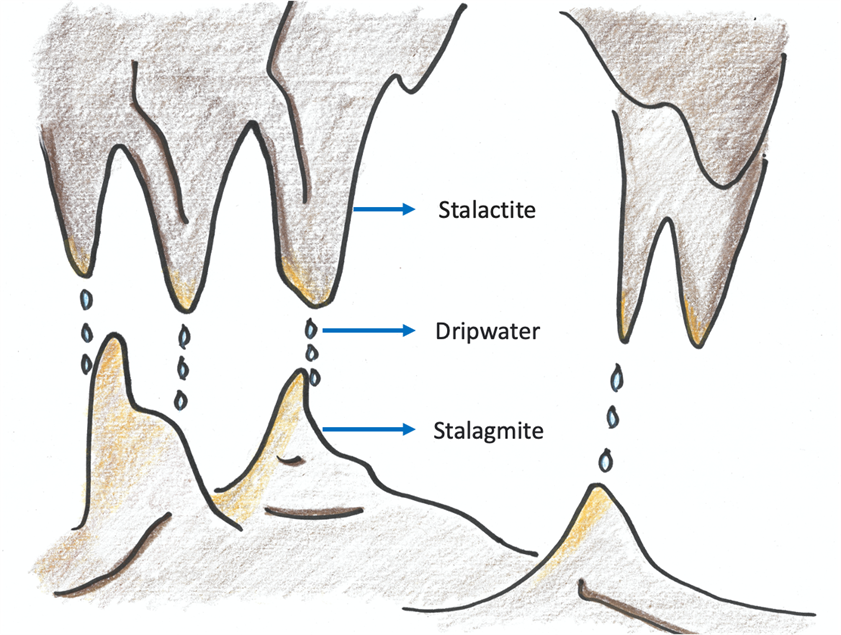
- Stalactite:
- Made of minerals and hanging from a cave ceiling (stalactites hold "tite" to the ceiling)
- Dripwater:
- Rich in minerals from rocks and soil
- Stalagmite:
- Made of minerals and growing from a cave floor
Lava Caves (tubes)
This is also a common cave type on Earth. The center of Earth is filled with magma. You can think of something like chocolate lava cakes. Something gooey is inside! Once magma comes to the surface, it is called lava. Lava released by volcanic eruptions flows like rivers called lava flow. The surface of lava flows can form a crust after being cooled dramatically by exposure to air. Under the solid crust lava can keep flowing as it takes more time to cool down. This can create long tube-like caves.



https://www.nasa.gov/universe/using-a-cave-rover-nasa-learns-to-search-for-life-underground/
Let's create stalagmites using baking soda (CaCO3)
Use these instructions from the U.S. National Park Service: https://www.nps.gov/wica/learn/education/cave-crystals.htm
What is common between Mars and Earth caves?
Ancient people used to live in caves on Earth, maybe people in the future will go back to living in caves on Mars!? Let’s think about the benefit of living in caves logically. There is an important concept called “specific heat” in science. This means the amount of heat needed to raise the temperature of one gram of a substance one degree Celsius (°C). For example, it takes a few minutes for water in your kettle to boil. Water in the kettle cannot boil in a few seconds. It is because water has a high specific heat. It takes a lot of energy to raise one gram of water by one degree Celsius (°C).
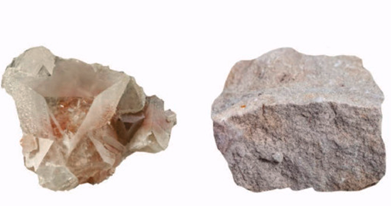
The pictures below are rocks called dolomite, and its specific heat is defined as 0.802 J/(g·°C) (Ji et al., 2024). The good thing about high specific heat substances is that it is harder to lose heat as well. Rocks are known to have high specific heat just like water. Caves on Earth and Mars are made of rocks. This means, if we can find a way to heat caves, it is hard for caves to lose heat. Because of this reason, cave temperatures on Earth are relatively stable.
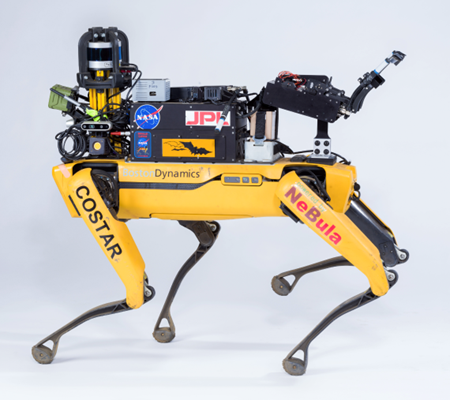
NASA has engineered a dog-like robot that can possibly explore caves on other planets in the future. This robot has been currently trained to explore caves on Earth. We may be able to see the inside of Mars cave images collected by these dog-like robots!
Can we possibly live in Mars caves?
This topic is something you need to explore and brainstorm. In the next chapter, we will discuss all the resources we need to live in caves. Also, we will think about how to maintain these resources in Mars caves. Your mission is to use your team’s imagination and evaluate if these resources can be always accessible in Mars caves. In the next chapter, you will work as a mission designer to create the future Mars cave houses. Below is the image that scientists created to live on Mars. As a mission designer, your team will create an image similar to this for Mars caves.
Now let's begin our adventure!
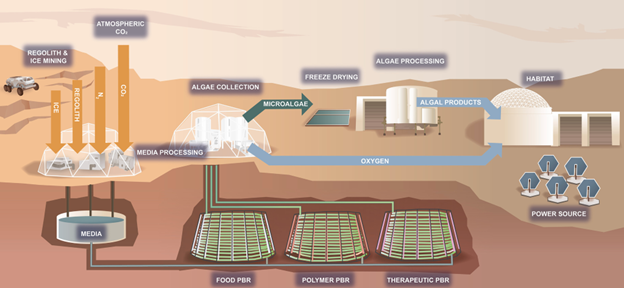
Visualization and Exploration with Emphasis on Astrobiology
Let's discuss what we'll need.
Oxygen
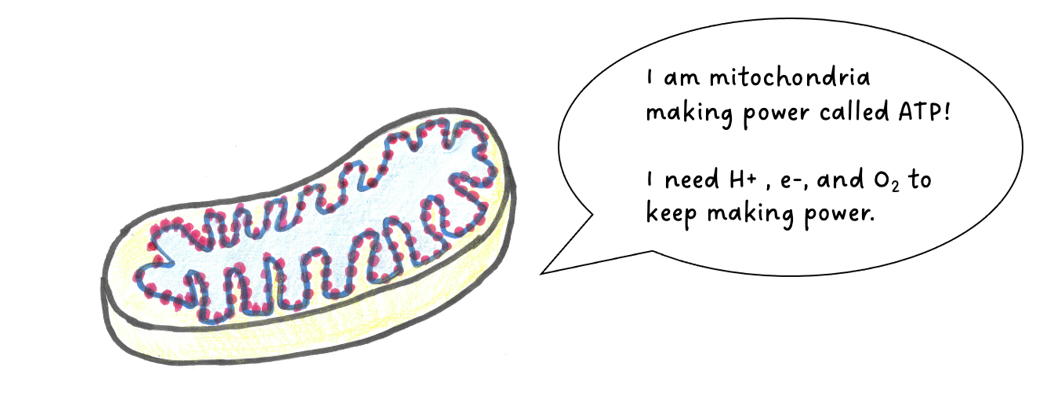
Everybody knows that we need oxygen. Can anybody explain why we need oxygen? Have you thought about it? It is because our body is made of cells, and each tiny cell needs oxygen to create fuels for our body called ATP (Adenosine Triphosphate).
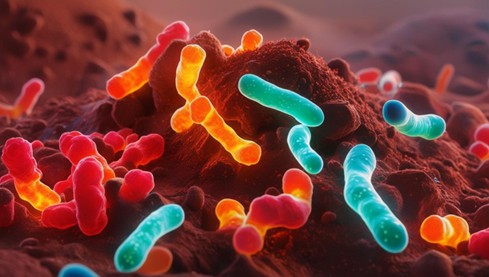
Cyanobacteria
Cyanobacteria is a hero of bacteria that dramatically changed the history of Earth and life. Current oxygen production on Earth from cyanobacteria is considered to be up to 20%. It does not take much space like plants you think of. Maybe we can use cyanobacteria for possible oxygen production?
Look at this beautiful image! Can you imagine what it is? Cyanobacteria are natural artists.
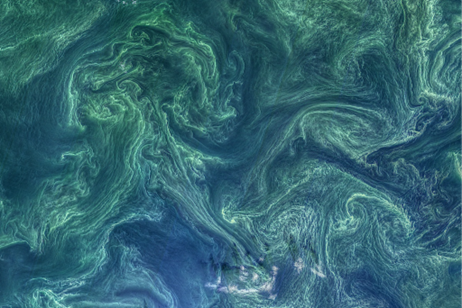
A great thing about cyanobacteria is that they reproduce very fast. They can double in numbers within five to six hours. They grow much faster than plants! This fast growth can be advantageous for oxygen production on Mars. Also, they do not need rain or much nutrition to survive.
Find out more from https://www.sciencedirect.com/science/article/pii/S0734975022000428
Here are more examples of how to produce oxygen on other planets. Can you come up with something else?
There is a type of bacteria called catalase positive bacteria . You have some on your skin too! They can break down hydrogen peroxide (a chemical you use to clean your wound or cut) and produce oxygen! Let's test if you can observe oxygen by adding hydrogen peroxide to your hand. Excitingly, scientists think there is natural hydrogen peroxide on Mars.
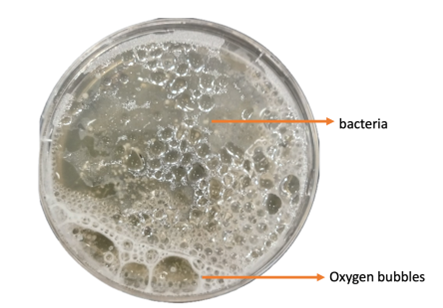
The reaction that causes this change is:
2 H2O2 → 2 H2O + O2
NASA also has a technology to convert Carbon Dioxide (CO2) into oxygen using high heat (800°C) https://www.nasa.gov/news-release/nasas-perseverance-mars-rover-extracts-first-oxygen-from-red-planet/ . It is called the Mars Oxygen In-Situ Resource Utilization Experiment (MOXIE).

Activity 10: Let's think about how oxygen is produced on Earth.
There is something important we need to know when we think about how oxygen is produced on Earth. That is bacteria! A tiny organism as big as one micrometer (1µm).
Challenge 10: (1) How big is 1µm? (2) Which produces more oxygen on Earth, plants or bacteria?
Type your answers here:
Now you can email your answer to someone, or download and save them.
Email your Answers:Water
Baking to get water>
Have you thought about why we need water? Same as oxygen which we just discussed; water is essential to produce energy for our body. Do you remember the name of this energy molecule in your body?
Mars used to have flowing water and we think these waters are trapped in Martian soil. One of the approaches to produce water is to bake these soils and generate water vapor. (https://ntrs.nasa.gov/api/citations/20160010258/downloads/20160010258.pdf) Unlike the heat needed to extract oxygen (800°C), scientists think we need moderate heat (60°C).
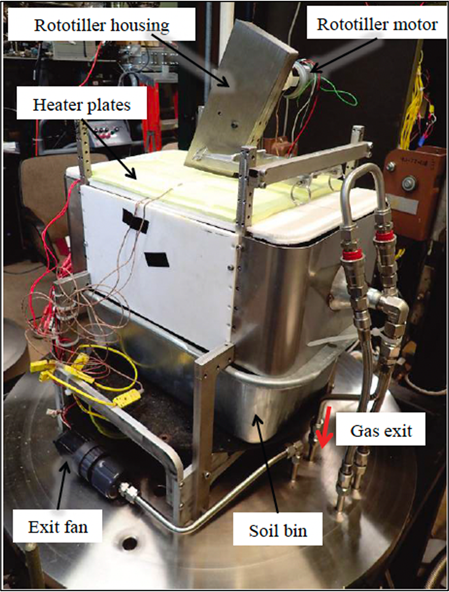
H2O in soil → H2O gas
SodaSorb
There is also a cool way to convert CO2 into water. Do you remember how much CO2 exists on Mars? Scientists are trying to utilize this large amount of CO2 to produce H2O (Boston et al., 2003). It is best if we can use the abundant resources available on Mars to produce what we need to survive rather than bringing necessary supplies from Earth. Remember, it takes about a year to two years to travel to Mars.
SodaSorb is a medical supply used on Earth, which is made of a chemical called calcium hydroxide Ca(OH)2. People also call it limewater. They are originally made for medical usage to remove exhaled CO2.
When Ca(OH)2 meets with H2O and CO2, it will produce CaCO3 and water. This means we need to invest water to initiate this chemical reaction, but we will end up producing more water. Scientists visualize the system below to create continuous production of water on Mars using CO2.
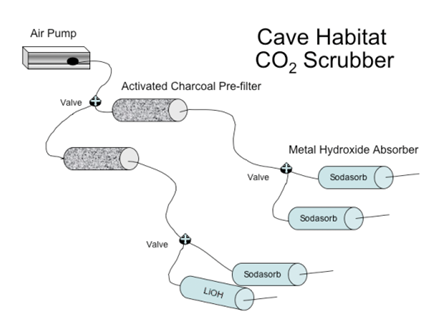
Ca(OH)2 + H2O + CO2 —> CaCO3 + 2H2O
Ice Caves
Excitingly, Mars has subsurface ice. There seems to be more ice around the North pole. (https://www.nasa.gov/solar-system/nasa-is-locating-ice-on-mars-with-this-new-map/) Scientists also predict that there are ice caves on Mars. (https://www.sciencedirect.com/science/article/abs/pii/S0019103520305911).
If we live in ice caves on Mars, that will provide us easy access to water. Scientists explored which Mars caves would be the most promising candidates, and one of the best sites are Mars caves in glacial cracks with a gentle horizontal entrance (Vidmachenko, 2024 ). Instead of living in caves that have a sharp vertical entrance, it makes sense to select the one that has gentle slopes, doesn't it?

Catalase Positive Bacteria
As we mentioned, these bacteria can break down hydrogen peroxide into water and oxygen. If we can perform this process on Mars, we can obtain both valuable resources at the same time. In 2003, scientists discovered hydrogen peroxide on Mars! (https://ntrs.nasa.gov/citations/20030066748)
Now you know that these bacteria live on your skin, so one day we may be able to produce both water and oxygen using your own skin bacteria on Mars?
One of the famous examples of catalase positive bacteria on your skin is called Staphylococcus epidermidis. Let’s take a look at how these bacteria look under electron microscope. Electron microscopes allow us to observe the surface structure of bacteria, and it creates 3D like images.
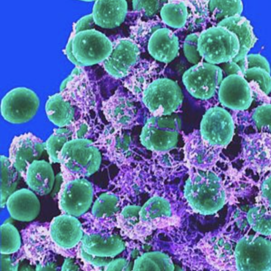
2 H2O2 → 2 H2O + O2
Light
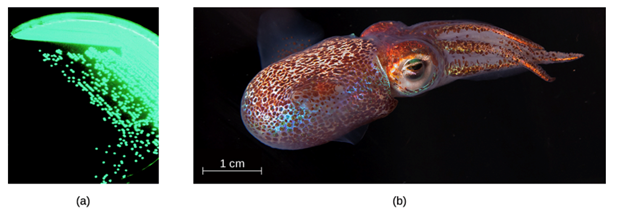
Shining Bacteria and Microorganisms
Have you heard about bioluminescent bacteria? There are lots of microorganisms on Earth that can produce light. If we utilize these bioluminescent microorganisms, we do not have to worry about making outlets and bringing light bulbs from Earth. The image below is a beautiful example of blue fluorescent light. Some scientists have already created a light bulb called Biobulb with bacteria and they don’t have to be connected to outlets (Smithsonian magazine, 2013).

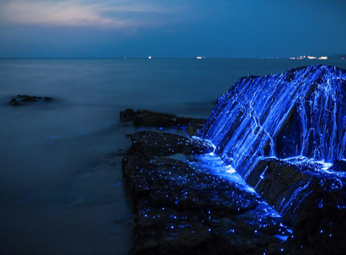
Sea Firefly (Cypridina hilgendorfii)
These are tiny organisms from Japan, and during World War II, Japanese soldiers used them as light when they had no access to power.

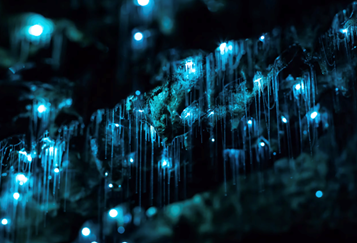
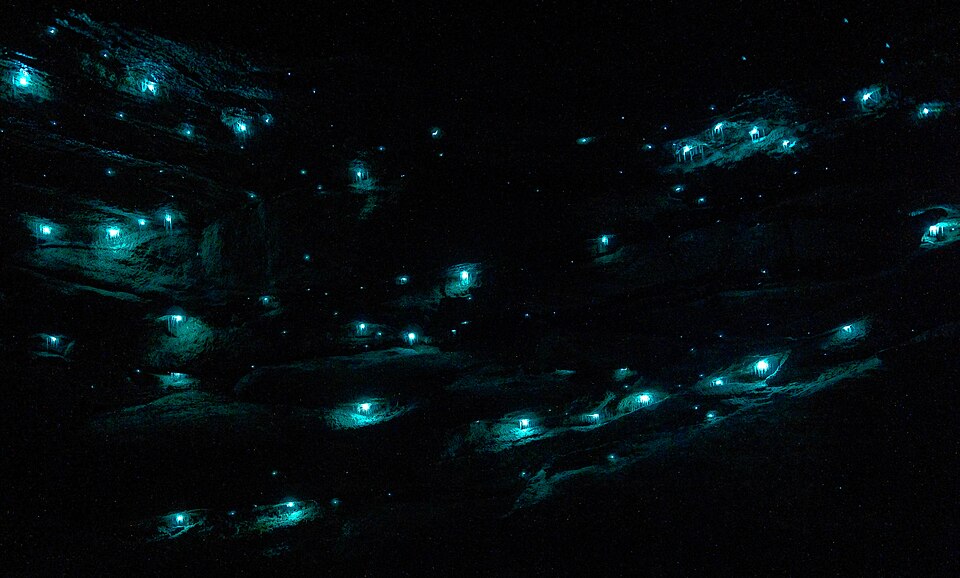
Glow Worms
There are also worms that grow only in caves and create beautiful lights. These worms are indigenous organisms, which means you only see them in specific regions of the world.
Activity 11: Glow Lights
Watch this video: https://www.nationalgeographic.com/travel/article/video-glowworm-cave-new-zealand
Research how to produce your own bioluminescent light with organisms similar to what we've learned about.
Products like the Bio-Orb by PyroFarms
allow your to care for your own living algae that will give off light.
Carolina Biological carries
Dinoflagellates and products for their care as well and provides guides to keep them healthy.
Other options exist as well, what can you find? Explore what it would be like to maintain your own
source of light created by life. Take a look at the resources needed and care required.
Think about what life would be like living under their glow. What tasks would be easier or harder? What in your environment might look different?
Type your answers here:
Now you can email your answer to someone, or download and save them.
Email your Answers:Food
Cyanobacteria
We mentioned cyanobacteria earlier when we discussed how to secure oxygen. Some scientists think that these bacteria can be a valuable food source! One team tested what cyanobacteria can grow using Mars’ regolith simulant (simulated Mars rocks) and discovered Nostoc muscorum grows the best using Mars minerals (Macario et al, 2022). https://pubmed.ncbi.nlm.nih.gov/35865930/
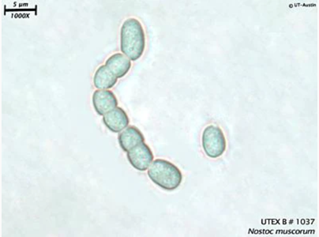
Also, there are cyanobacteria called Spirulina and it is reported to be very nutritious. Spirulina is a nutrient-dense cyanobacteria which are composed of protein, carbohydrates, vitamins, minerals, essential fatty acids, antioxidants and pigments including chlorophyll A and Phycocyanin (Gogna et al., https://pubmed.ncbi.nlm.nih.gov/35916491/). There are some restaurants that already incorporate Spirulina in their menu too. Maybe we should start doing a bacteria tasting party to test which bacteria taste the best too!

CO2 Sugar
Now we are all familiar with the fact that Mars is filled with CO2. Excitingly, NASA started the Carbon Dioxide Challenge Program in 2019 which awards funding for innovative research. ( https://www.nasa.gov/prizes-challenges-and-crowdsourcing/centennial-challenges/co%e2%82%82-conversion-challenge/). Scientists are currently trying to investigate if it is feasible to convert carbon dioxide into sugar. If we are successful, we can feed bacteria that we have been discussing, and of course we can use sugar for our food as well.
The possible scenario to produce sugar out of CO2 is the process below. We call it abiotic conversion. However, there are many challenges related to making this reaction happen on Mars. You can be a scientist to solve this big science problem in the future! You can find our more from this link: https://www.nasa.gov/technology/nasa-awards-750000-in-competition-to-convert-carbon-dioxide-into-sugar/
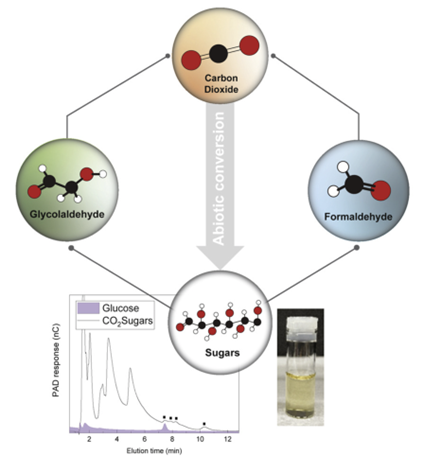
CO2 → CH2O → C6H12O6
Power and Energy
Shewanella Oneidensis MR-1
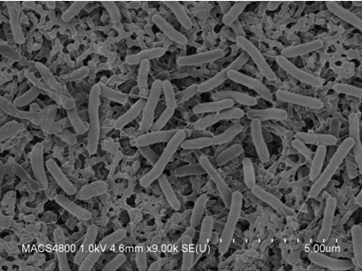
What types of power do we have? Most of the power we use everyday is made from turbines. We also have solar power which is getting more popular nowadays. How about creating power and electricity using bacteria? NASA is studying the bacteria called Shewanella oneidensis MR-1 These bacteria living in soil and water are able to export electrons outside of cells and that produce electric currents. NASA sent these bacteria to the International Space Station in 2018 to study how microgravity impacts these bacteria growth (NASA, 2024). Maybe these bacteria can be utilized to produce power on Mars!?
Bathroom
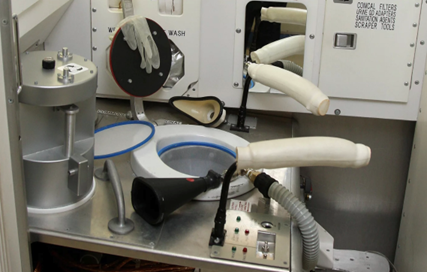
Have you thought about what is the best way to manage human waste in space? At the International Space Station, human urine is recycled using a special equipment called Urine Processor Assembly (UPA). Surprisingly, human urine can be processed to be drinkable water (NASA, 2023). Now we know NASA already has established a technique to take care of urine. How about the other one?
Scientists are already researching the system to convert human feces into something edible using bacteria. Scientists at Penn State University received the funding from NASA and created a bioreactor with the bacteria that can break down feces. During this process, methane gas can be produced and that feeds bacteria such as Methylococcus capsulatus (Penn State University, 2018). These bacteria are already used to feed fish and called bacteria protein. Scientists are investigating if they can create edible bacteria for humans as well.
Further Exploration
This content is not required to complete the missions below, but you may choose to learn how humans live in other habitats and extreme environments here on Earth.
Have we covered everything that humans will need if they live in Mars caves? Can you think of other things that would would make a habitat a better home?
NASA experiments with habitats in many environments. People live and work in these habitats to help us learn what we need to prepare for when we send humans out into space.
Take a look at NASA's Analog Missions to explore how this work is done.
Humans also live in some extreme environments here on Earth. The National Science Foundation (NSF) maintains a research station at the South Pole! It is called Amundsen-Scott South Pole Station and is a place where many innovations have been made to support human habitation.
Other countries around the world run their own analog astronaut missions. So do space companies. Can you find any?
Keep an eye out for how these missions handle the challenges we have already learned about. Do they provide solutions for other human needs as well? You may find them addressing:
- Communications
- Physical Fitness and Health
- Mental Health and Wellness
- Entertainment and Recreation
- More?
Missions
Mission 1
Using all the knowledge from this chapter, let's create conceptual cave houses. You do not have to be concerned with technical feasibility. Just enjoy and use your imagination!
- Oxygen
- Water
- Light
- Food
- Power & Energy
- Bathroom
- Other topics you may have explored
If you are working in a team, you may want to divide the topics up between you, or work together on each.
You can make sketches and drawings, write descriptions, and even use craft supplies to build a model of your cave habitat!
- A large cardboard box, cardboard sheets, foam-board, or three section poster-board
- Construction Paper, card-stock, scrapbooking paper
- Cardboard tubes, egg cartons, foam trays
- Wooden dowels, chopsticks, toothpicks, straws
- Cloth scraps, cotton balls
- Pipe cleaners, twist ties, string
- Tape, glue, glue sticks, patterned washi tape, stapler
- Pencils, markers, paint & brushes
- Modeling clay, air dry clay, clay shaping tools
- Scissors, exacto-knives, hole punchers
- Glitter, sequins, beads
- Mini-figures or toy space models for props
- Take it to the next level:
- Batteries
- Wires
- LED lights and resistors
- Switches and buttons
- Sensors
- Arduino or other microcontrollers
- Electrical tape or soldering equipment
Mission 2
Now that you have planned for your Mars cave habitat, prepare to share! Prepare a presentation to pitch your team's ideas. It should be about seven to ten minutes long. You might want to make a poster or a slideshow, or display your model and talk about what you built and why.
How did you plan for each resource? Why do you think your team's idea is unique or will do the best at providing for residents?
Acknowledgements
This curriculum was developed with the funding from NASA SCoPE at Arizona State University: https://scope.asu.edu/
And with help from:





References
- Asner, G. and Garber, S.G. (2019) Origins of 21st Century Space Travel. NASA History Division, Washington D.C.
- BioTechniques Journal (2018) The pathogenesis of Staphylococcus epidermidis, https://www.biotechniques.com/microbiology/the-pathogenesis-of-staphylococcus-epidermidis/
- Cestellos-Blanco, S. et al. (2022) Toward Abiotic Sugar Synthesis from CO2 Electrolysis, Joule 6 (10): 2304–23, https://doi.org/10.1016/j.joule.2022.08.007
- Gogna, S. et al. (2023) Spirulina – An Edible Cyanobacterium with Potential Therapeutic Health Benefits and Toxicological Consequences. J. Am. Nutr. Assoc. 42(6):559–572. doi: 10.1080/27697061.2022.2103852. PMID: 35916491.
- Linne, D.L., Kleinhenz, J.E., Bauman, S.W., and Johnson, K.A. (2016) Extraction and Capture of Water from Martian Regolith: Experimental Proof-of-Concept. American Institute of Aeronautics and Astronautics, https://ntrs.nasa.gov/api/citations/20160010258/downloads/20160010258.pdf
- Ji, M., Lv, L., Zhang, A., and Zhou, H. (2024) Research on Dolomite-Based Shape-Stabilized Phase Change Materials for Thermal Energy Storage. Journal of Energy Storage 75: 109745. https://doi.org/10.1016/j.est.2023.109745
- Macário, Inês P. E. et al. (2022) Cyanobacteria as Candidates to Support Mars Colonization: Growth and Biofertilization Potential Using Mars Regolith as a Resource. Frontiers in Microbiology 13. https://doi.org/10.3389/fmicb.2022.840098
- Mapstone, L.J., Mara, N.L., Purton, S., Crawford, I.A., and Dartnell, L. (2022) Cyanobacteria and Microalgae in Supporting Human Habitation on Mars. Biotechnology Advances 59: 107946. https://doi.org/10.1016/j.biotechadv.2022.107946
- NASA (2007) NASA Orbiter Finds Possible Cave Skylights on Mars, https://science.nasa.gov/solar-system/planets/mars/nasa-orbiter-finds-possible-cave-skylights-on-mars/
- NASA (2020) Nebula Spot, https://www.jpl.nasa.gov/robotics-at-jpl/nebula-spot/
- NASA (2021) NASA’s Perseverance Mars Rover Extracts First Oxygen from Red Planet, https://www.nasa.gov/news-release/nasas-perseverance-mars-rover-extracts-first-oxygen-from-red-planet/
- NASA (2021) NASA Awards $750,000 in Competition to Convert Carbon Dioxide into Sugar, https://www.nasa.gov/technology/nasa-awards-750000-in-competition-to-convert-carbon-dioxide-into-sugar/
- NASA (2023) View of the Earth’s Magnetic Field, https://svs.gsfc.nasa.gov/20068/
- NASA (2023) NASA Is Locating Ice on Mars With This New Map, https://www.nasa.gov/solar-system/nasa-is-locating-ice-on-mars-with-this-new-map/
- NASA (2023) NASA Achieves Water Recovery Milestone on International Space Station, https://www.nasa.gov/missions/station/iss-research/nasa-achieves-water-recovery-milestone-on-international-space-station/
- NASA (2023) CO2 Conversion Challenge, https://www.nasa.gov/prizes-challenges-and-crowdsourcing/centennial-challenges/co₂-conversion-challenge/
- NASA (2024) A Poem for Europa by U.S. Poet Laureate Ada Limón, https://www.youtube.com/watch?v=EgWbeDNPD6o
- NASA (2024) Write a Poem About Space, https://www.jpl.nasa.gov/edu/resources/project/write-a-poem-about-space/
- NASA (2024) Latest Weather at Gale Crater, https://mars.nasa.gov/layout/embed/image/mslweather/
- NASA (2024) Planetary Cave Rovers, https://ai.jpl.nasa.gov/public/projects/cave-rovers/
- NASA (2024) Mars Oxygen ISRU Experiment Instrument for Mars 2020 Rover (MOXIE), https://science.nasa.gov/resource/mars-oxygen-isru-experiment-instrument-for-mars-2020-rover-is-moxie/
- NASA (2025) Deep Stars Maps 2020, https://svs.gsfc.nasa.gov/4851/#media_group_319127
- NASA (2025) Humans to Mars, https://www.nasa.gov/humans-in-space/humans-to-mars/
- NASA (2025) Mars Odyssey, https://science.nasa.gov/mission/odyssey/
- NASA (2025) Mars – NASA Science, https://science.nasa.gov/mars/
- NASA (2025) Ocean Color Image Gallery, https://oceancolor.gsfc.nasa.gov/gallery/716/
- NASA (2025) Characterizing the Oxidizing Properties of Mars’ Polar Regions, https://ntrs.nasa.gov/citations/20030066748
- NASA (2025) Micro-12 (SpaceX-15), https://www.nasa.gov/ames/space-biosciences/micro-12/
- National Geographic (2016) Dazzling Video of Glowworm Cave in New Zealand, https://www.nationalgeographic.com/travel/article/video-glowworm-cave-new-zealand
- National Caves and Karst Research Institute (2021) Learn about caves, https://nckri.org/caves/about/
- NPR News (2018) Making Space Food With Space Poop, https://www.npr.org/sections/thesalt/2018/02/03/582968023/making-space-food-with-space-poop
- OpenStax (2025) Microbiology Chapter 4, Gammaproteobacteria, https://openstax.org/books/microbiology/pages/4-2-proteobacteria
- Park, N., Hong, I.S., and Jung, J. (2022) Investigation of the Characteristic Nighttime Temperature of Potential Caves on Mars. J. Astron. Space Sci. 39(4):141–144. https://doi.org/10.5140/JASS.2022.39.4.141
- Penelope, J., Frederick, R.D., and Hildreth-Werker, V. (2003) Human Utilization of Subsurface Extraterrestrial Environments: Final Report. KIP Data Sets and Technical Reports 87. https://digitalcommons.usf.edu/kip_data/87
- Resio, L.C. (2023) Dolomite Thermal Behaviour: A Proposal to Establish a Definitive Decomposition Mechanism in a Convective Air Atmosphere. Open Ceramics, 100405–5. https://doi.org/10.1016/j.oceram.2023.100405
- Schörghofer, N. (2021) Ice Caves on Mars: Hoarfrost and Microclimates. Icarus 357: 114271. https://doi.org/10.1016/j.icarus.2020.114271
- Smithsonian Magazine (2013) One Day We’ll Light Our Homes With Bacteria, https://www.smithsonianmag.com/smart-news/one-day-well-light-our-homes-with-bacteria-81394/
- Smithsonian Magazine (2019) How Studying Bioluminescent Creatures Is Transforming Medical Science, https://www.smithsonianmag.com/science-nature/how-bioluminescent-creatures-are-transforming-medical-science-180973690/
- TripAdvisor (2025) Kipposhi’s Blue Ramen, https://www.tripadvisor.com/LocationPhotoDirectLink-g1066456-d17853045-i414596460-Kipposhi-Shibuya_Tokyo_Tokyo_Prefecture_Kanto.html
- University of Texas, Austin (2025) UTEX 1037 Nostoc muscorum, https://utex.org/products/utex-1037?variant=30991211003994
Additional Resources
- Find Mars in the night sky!
- Try Stellarium! It can help you visualize the sky as it looks from your own home. It runs on many devices and within a web browser.
- Explore Mars in detail!
-
Set your target to Mars in the
Gazetteer of Planetary Nomenclature, a resource of NASA, the United States Geological Survey, and the
International Astronomical Union. You can view all sorts of features with lots of extra data. Maybe you'll
even spot the entrance to a cave system!
You can also use it to explore other parts of the solar system. - Why is it named that?
- Everything in our solar system got it's name for a reason, from the planets and moons themselves, to all the locations on them. Some are named for figures from mythology, and others after great explorers. You may find more named for pieces of our history and culture, or even scientists or artists who made great contributions to society. Explore Surface Feature Categories (Themes) and find where all the names come from.
- Teachers: Teach more about caves:
- The United States Geological Survey has a full curriculum on caves designed for K-3. You can find the pdf documents here: https://pubs.usgs.gov/gip/70043840/